Russian
 English


Polymarket vs. The World
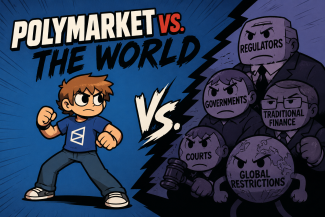
Until recently, prediction markets existed in a unique state of legal uncertainty. Some regulators viewed them as collective forecasting tools, others as a form of gambling, still others as a new class of financial derivatives, while certain jurisdictions did not regulate them at all. However, developments over the past few months demonstrate that the era of regulatory ambiguity is coming to an end.
The primary focus of regulators remains Polymarket, the world's largest prediction market. It is around this platform that new judicial and regulatory practices are taking shape, gradually defining the rules for the entire industry. Over the past year, restrictions on the platform have been introduced or strengthened across several European countries, including France, Germany, Italy, Belgium, and Spain. National regulators are increasingly reaching the same conclusion: prediction markets cannot operate outside the existing frameworks governing gambling or financial markets.
At the same time, regulatory scrutiny is intensifying in Asia. Singapore, Taiwan, Australia, and a number of other jurisdictions have restricted access to similar platforms, citing the absence of the necessary licenses and risks to consumers. As a result, the list of countries where Polymarket is restricted or prohibited continues to expand.
The U.S. market remains the most illustrative example. While regulators several years ago were still attempting to determine the legal nature of prediction markets, the discussion today centers on the specific rules under which they should operate. A landmark precedent was established through the case brought by the U.S. Commodity Futures Trading Commission (CFTC) against Polymarket, which resulted in a monetary penalty and a requirement to cease offering unregistered contracts. This case effectively laid the foundation for the industry's future regulatory framework.
Over the past year, the regulatory debate in the United States has evolved further. The CFTC has begun developing dedicated rules for prediction markets, determining which categories of events may be traded and which should be prohibited. At the same time, several legal proceedings involving Polymarket's competitor, Kalshi, have established another important precedent: prediction markets are increasingly being viewed not as gambling products, but as regulated financial instruments.
Notably, major financial institutions are no longer ignoring this sector. During 2025–2026, traditional exchanges and brokerage firms began entering the prediction market space, while aggregate trading volumes on leading platforms exceeded $40 billion. This reflects the gradual institutionalization of the industry and its integration into the existing financial system.
Accordingly, the defining trend of 2026 is not another wave of platform bans, but rather the disappearance of regulatory uncertainty. Whereas regulators previously debated what prediction markets are, the discussion now focuses on how they should be regulated.
For new projects entering the prediction market sector, this is a critical development. The winners will not be those platforms that remain in regulatory gray areas the longest, but those capable of integrating into the emerging regulatory framework. The story of Polymarket demonstrates that prediction markets are gradually ceasing to be a gray-area product and are evolving into a fully-fledged segment of the global financial market.